- Blog
- November 26, 2026
Why Removing SSNs Isn't Enough to Protect Client Tax Information in AI
QUESTK2 Technologies

We have talked to a lot of accounting firms about AI this year, and nearly all of them have the same rule: never paste a Social Security number into ChatGPT, Copilot or Claude.
It's a good rule. But it protects far less than most firms assume. The SSN is one detail out of dozens that identify a client.
This post looks at what still slips through, what the rules actually cover, and where PII masking comes in.
The "safe" prompt
Here's a prompt we've seen some version of more times than we can count. A staff member is prepping for a client meeting and, to their credit, leaves the SSN out:
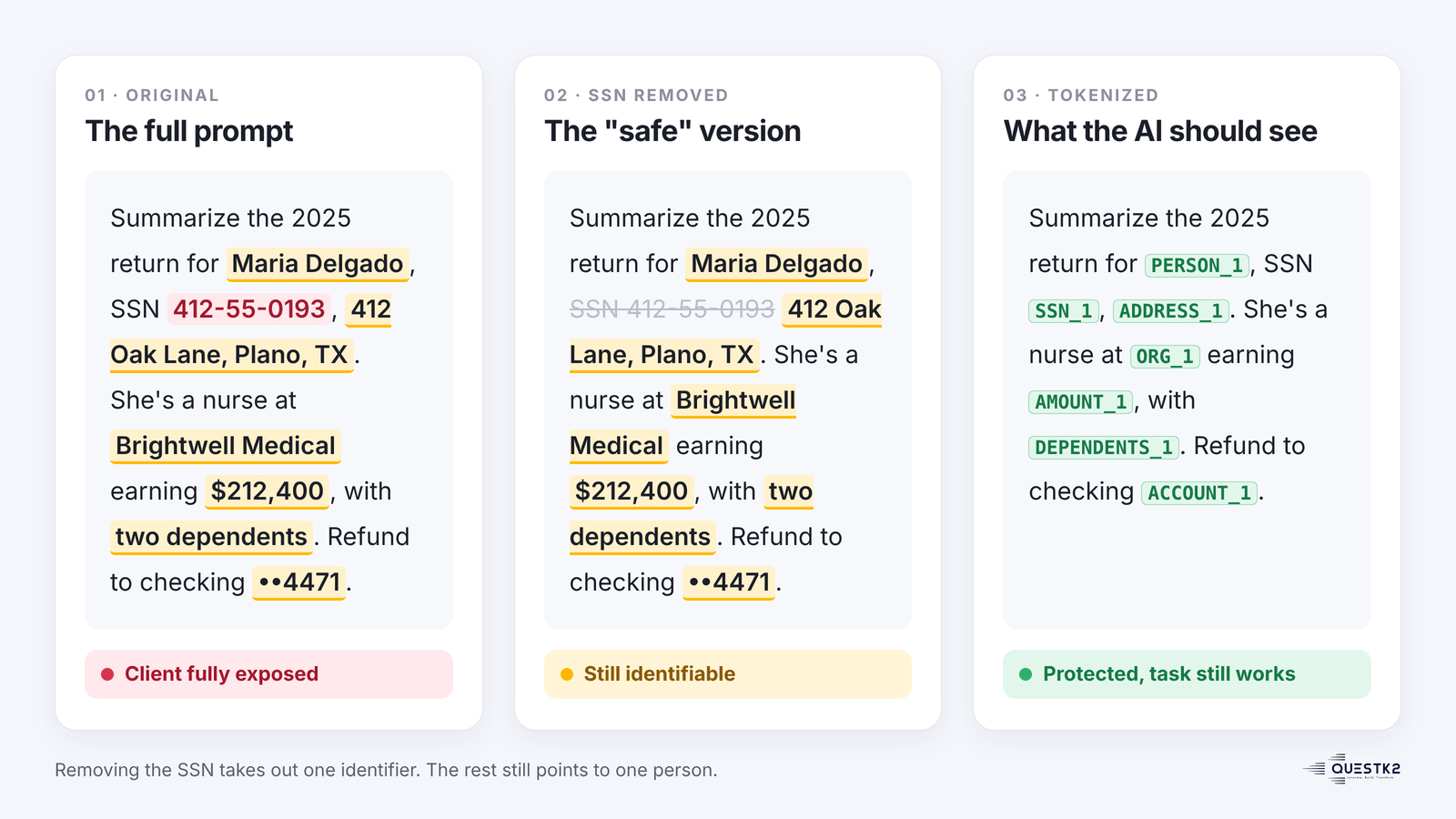
"Summarize the 2025 return for Maria Delgado, 412 Oak Lane, Plano, TX. She's a nurse at Brightwell Medical earning $212,400, with two dependents, and her refund goes to her checking account ending 4471. Flag anything that changed from last year."
(Maria isn't real. The prompt pattern very much is.)
No SSN. Rule followed. But look at what's still sitting there:
- Her full name and home address
- Her employer and her job
- Her income, down to the dollar
- Her family situation
- Part of her bank account number
None of those is an ID number. All of them together point to exactly one person.
It takes fewer details than you'd think
This isn't a new idea. Privacy researchers have been making this point for more than 25 years.
- The classic example: Latanya Sweeney found that 87% of the US population could likely be identified by just three things: 5-digit ZIP code, gender and date of birth.
- Three details. That's it.
- A tax file has... a lot more than three details.
So stripping the SSN removes one identifier and leaves a dozen others behind. It feels like a safeguard. It's mostly a speed bump.
What the rules actually say
Quick caveat: we're not lawyers, and this isn't legal advice. But the rules on client tax data are pretty clear that the SSN isn't the line.
- Section 7216. The IRS rules under Section 7216 limit how preparers use and disclose client information. They define "tax return information" broadly: anything a client provides in connection with preparing a return, including their name, address and identifying number.
- The FTC Safeguards Rule. The Safeguards Rule names tax preparation firms as covered businesses and asks them to protect customer information in general. Not a list of fields. Customer information.
So a prompt with the SSN removed can still be full of protected information. Whether a specific use is a problem depends on the details (which is exactly why your compliance folks should be in this conversation). But the starting question isn't "did we remove the SSN?"
Four ways firms try to fix it
When firms do go further than the SSN rule, they tend to land on one of four approaches. Some work a lot better than others.
| Approach | What it does | Client still identifiable? | Can AI still do the task? | Real values in the answer? |
|---|---|---|---|---|
| Removing | Deletes the sensitive details | No | Often not, the context is gone | No |
| Blacking out | Replaces details with "XXXX" or [REDACTED] | No | Often not | No |
| Fake values | Swaps in made-up names and numbers | No | Yes | Only if someone swaps them back by hand |
| Tokenizing (PII masking) | Replaces each detail with a consistent placeholder, such as PERSON_1 or ACCOUNT_1 | No | Yes | Yes, for authorized staff |
The short version:
- Removing and blacking out protect the client, but they usually break the task. The AI can't tell you what changed from last year if the numbers are gone.
- Fake values kind of work, until someone has to swap everything back by hand. (Nobody wants that job in March.)
- Tokenizing keeps the shape of the data, so the AI can still do the work without ever seeing the real values.
What good PII masking actually looks like
If there's one thing we'd push on, it's this: don't build your protection on people remembering a rule. People are busy. It's tax season. Things get pasted.
Good PII masking does four things:
- It detects automatically. Names, account numbers, income figures, addresses. Not just SSNs, and not just when someone remembers.
- It masks before the prompt leaves the firm. Once client data reaches an outside AI service, you can't really take it back.
- It restores only for the right people. Staff working on that client's file see the real values in the AI's answer. Nobody else does.
- It keeps a record. What was shared, by whom, and when. Because at some point, a client, an auditor or a regulator is going to ask.
Where PromptVault comes in
This is the problem we built PromptVault for, so yes, we're a little biased. Here's what it does:
- Finds sensitive client information in a prompt, such as names, account numbers and tax figures
- Replaces it with secure tokens before anything reaches the AI model
- Shows the real values in the response only to authorized staff
- Logs every interaction for your records
Your team keeps using the AI tools it already relies on, such as ChatGPT, Claude or Copilot. Client data stays protected. If you'd rather see it than read about it, our 2-minute bank statement walkthrough shows the whole thing.
The bottom line
Keep the SSN rule. Seriously. Just don't stop there.
Client tax information isn't one field. It's everything that identifies a client, and in AI, ALL of it needs protecting before it leaves the firm.
Curious where your firm stands? Take our 2-minute AI Data Exposure Assessment, or book a time with our team. And if you're newer to this topic, our guide on whether CPA firms can safely use AI with client tax data is a good place to start.
Got a question, or a prompt horror story of your own? We'd genuinely like to hear it.
Frequently asked questions
Is removing the SSN enough to make client data safe for AI?
No. A client's name, address, employer and income can identify them just as easily, and all of it counts as tax return information.
What counts as tax return information?
Under Section 7216, it includes anything a client provides in connection with preparing a return, such as their name, address and identifying number.
What's the difference between redacting and tokenizing data?
Redacting removes or blacks out details, which protects the client but often stops the AI from doing the task. Tokenizing replaces details with placeholders, so the AI can still work and authorized staff see the real values in the response.